
/* 🎯 Introduction */
🎯 Quick Answer
The best TrustMark vs Checkatrade website integration focuses on static trust signals, like SVG logos, to protect your site’s speed and Core Web Vitals.
- Heavy JavaScript widgets from accreditation sites can severely slow down your website, costing you leads.
- A “Hybrid Static” approach uses a fast-loading visual badge that links to your official profile without loading slow scripts.
- For local businesses in areas like Woodford, mobile page speed is a critical trust signal for both users and Google.
Continue reading to learn how to build trust without sacrificing the performance that wins local customers.
You have likely invested significant time and money into accreditations like TrustMark or Checkatrade to build trust, but are the badges on your website actively costing you customers? For tradesmen in the UK, especially in competitive local markets like Woodford, a slow-loading website is a major liability. According to the OECD Digital Economy Outlook 2024 (Volume 2), which explores emerging digital priorities, robust digital infrastructure is critical for modern businesses. This article tackles a critical, often-overlooked question: how do you display these vital trust signals without damaging your site’s performance?
We will move beyond a simple comparison of which badge is better. Instead, we will dive into the technical impact of their website widgets and introduce the “Hybrid Static” integration concept. This guide is designed to show you how to maintain trust and credibility while ensuring your site is fast, responsive, and ready to convert leads. We will explore why effective TrustMark vs Checkatrade website integration is less about the badge itself and more about how it loads, proving that in 2025, the ultimate trust signal is a high-performance website.
👤 Written by: Jamie Grand Reviewed by: Jamie Grand, Technical Web Developer Last updated: 27 December 2025
ℹ️ Transparency: This article explores website integration for trade accreditations based on technical performance data and web development best practices. Some links may connect to our ‘Zero Upfront’ managed website service. All information is reviewed by Jamie Grand. Our goal is to provide accurate, helpful information to empower UK tradespeople.
Table of Contents
The Trust Landscape in 2025: Badges vs. Performance
Tradespeople rightly ask whether TrustMark (Government-endorsed) or Checkatrade (strong consumer brand) offers more value. While both have their merits, the more important question is how digital trust is actually built.
TrustMark Explained
TrustMark is the only Government-endorsed quality scheme for work carried out in or around the home. It focuses heavily on technical competence, good trading practices, and customer protection. Because of this rigorous vetting, it is often the preferred accreditation for larger contracts, grant-funded work, and homeowners looking for assurance on significant structural projects.
Checkatrade Explained
Checkatrade operates primarily on consumer brand recognition. It is a household name in the UK, driven by massive marketing campaigns and a review-based system. For domestic jobs—like emergency plumbing or quick electrical fixes—consumers often look for the Checkatrade logo as a shorthand for “vetted and reviewed.”
The Academic View on Trust
However, displaying a logo is only half the battle. As groundbreaking research from UCL (University College London) on the mechanics of trust suggests, the goal should be to “encourage trustworthy action,” not just help individuals “appear more trustworthy.”
In the context of a website, a fast, seamless, and reliable user experience is a “trustworthy action.” Conversely, a site that lags, jumps around, or fails to load on a mobile device undermines that trust, regardless of the badges displayed. Therefore, the best accreditation strategy is one that is implemented on a high-performance website. The badge provides the initial signal, but the site’s speed and usability confirm it.
Table 1: TrustMark vs. Checkatrade at a Glance
| Feature | TrustMark | Checkatrade |
|---|---|---|
| Primary Focus | Technical Standards & Consumer Protection | Consumer Reviews & Marketing |
| Backing | Government Endorsed | Brand Recognition |
| Best For | High-value projects, tenders, grant work | Domestic, high-volume work, emergency repairs |
| Verification | On-site inspection, financial checks | Customer reviews, background checks |
| Website Integration | Logo/Link | Logo/Link/Dynamic Widget |
The Hidden Cost: How "Widget Weight" Kills Your Speed & SEO
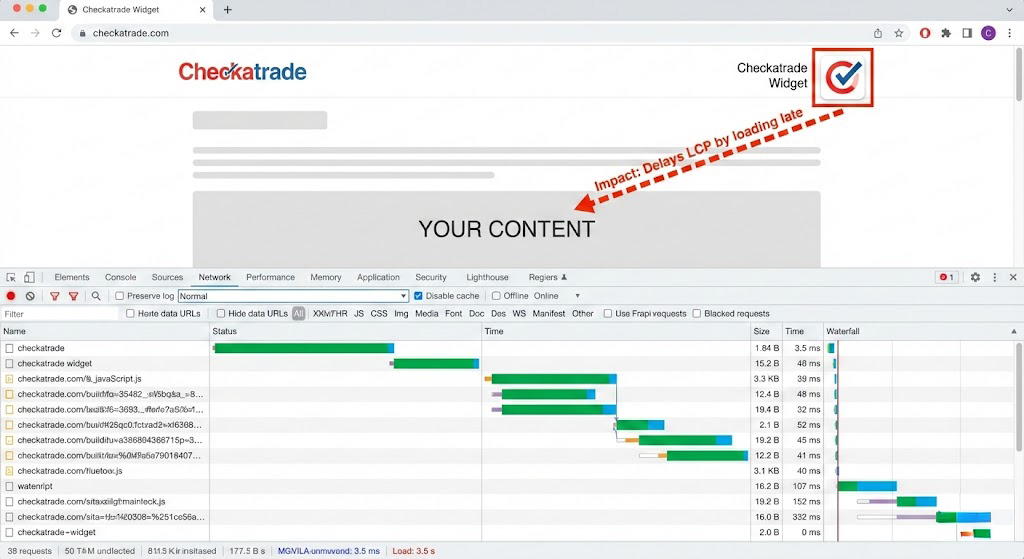
What AI and generic guides often miss when discussing TrustMark vs Checkatrade website integration is the technical cost. The dynamic, feature-rich review widgets provided by services like Checkatrade come with a hidden performance price tag paid in kilobytes (KB) of JavaScript, which can devastate your Core Web Vitals (CWV).
What is Widget Weight?
“Widget weight” refers to the size of the code required to run the dynamic badge on your site. When you embed a standard review widget, your user’s browser must download, parse, and execute that code. On a desktop with high-speed Wi-Fi, this might be negligible. However, for a potential customer in Woodford searching for an electrician on their mobile phone with an average 4G signal, every kilobyte counts.
JavaScript's Impact on Core Web Vitals
The Checkatrade widget impact on page speed is primarily felt in two metrics:
- Largest Contentful Paint (LCP): Heavy third-party scripts can “block the main thread.” This means the browser pauses loading your main content (like your headline or hero image) to figure out how to display the reviews widget. This delay increases your LCP time, which Google uses as a primary ranking factor.
- Cumulative Layout Shift (CLS): Widgets often load asynchronously, meaning they pop in after the rest of the page has loaded. This can cause your text and buttons to jump down the screen. If a user tries to click “Call Now” and the button moves because a widget just loaded, it creates a frustrating experience that Google penalizes.
The WordPress Problem vs. Jamie's Advantage
Standard WordPress sites often struggle significantly with this issue. Because WordPress relies on plugins, adding a review widget often involves adding yet another layer of code to an already bloated stack.
In contrast, a custom-coded approach (like the React/Laravel stack we use) allows for precise control. We can ensure that Core Web Vitals for Tradesmen Sites remain green by preventing these scripts from blocking the main thread.
This technical gap is widespread. The UK Government’s Cyber Security Skills 2024 report estimates that 30% of UK cyber firms have faced problems due to a technical skills gap. If dedicated tech firms struggle with technical implementation, it is unsurprising that local trade sites built on DIY platforms suffer from poor performance.
A slow site leads to higher bounce rates, which tells Google your page isn’t a good answer. Reducing bounce rate for local services starts with ensuring your site loads instantly, regardless of how many accreditations you have.
Strategic Integration: The "Hybrid Static" Approach
So, how do you showcase your hard-won accreditation without slowing down your site? The answer is the “Hybrid Static” approach to TrustMark vs Checkatrade website integration, which gives you the best of both worlds: visual trust and elite performance.
Step 1: Use SVG for the Logo
Avoid using the heavy script provided by the review platform. Instead, download the official logo in SVG (Scalable Vector Graphics) format. SVGs are incredibly lightweight code-based images that scale perfectly to any size without ever looking pixelated or blurry. You can add this to your website code just like a standard image.
Step 2: Link to Your Official Profile
Instead of embedding a widget that pulls data from their server every time a user loads your page, make the SVG logo a simple hyperlink. Point this link directly to your public profile on the Checkatrade or TrustMark website. This allows customers to verify your accreditation with a single click, satisfying the need for transparency.
Step 3: Add a Text Callout
Below the logo, add a simple text line such as “Click to see our verified reviews on Checkatrade.” This text is readable by Google (great for SEO) and provides clear context to the user.
Benefits of Static vs Dynamic Trust Badges
- Speed: You eliminate third-party JavaScript fetch requests. Your site loads instantly.
- Trust: The logo is clearly visible, and verification is just one click away.
- Control: You control the design and placement, ensuring the badge fits your brand rather than breaking your layout.
This method is the foundation of our ‘Zero Upfront’ managed websites, ensuring our clients’ sites are always fast, trustworthy, and technically perfect from day one. By using static vs dynamic trust badges, we protect the user experience while still leveraging the authority of the accreditation.
Frequently Asked Questions
Is TrustMark better than Checkatrade for SEO?
Neither TrustMark nor Checkatrade directly improves your website’s SEO in the way quality content or backlinks do. The primary SEO benefit comes from the link from your profile on their high-authority domain back to your site. However, the biggest impact—positive or negative—comes from how you handle TrustMark vs Checkatrade website integration. A slow-loading widget can harm your Core Web Vitals and negatively impact rankings.
How to add Checkatrade reviews to my website without slowing it down?
The best way is to avoid using the official JavaScript widget. Instead, use a “Hybrid Static” approach: display a static SVG image of the Checkatrade logo on your site and make it a hyperlink to your public Checkatrade profile page. This provides the visual trust signal and proof of accreditation without loading any performance-damaging scripts, protecting your site’s speed.
Do I need both TrustMark and Checkatrade?
This depends on your trade and target customer. TrustMark is Government-endorsed and valued for its technical standards, often preferred for larger contracts. Checkatrade has strong consumer brand recognition driven by reviews. Many businesses choose the one that aligns best with their customer base, while some opt for both to cover all bases. The key is to integrate their badges efficiently on your website.
TrustMark accreditation cost vs value 2025
The value of TrustMark accreditation in 2025 lies in its signal of technical competence and government endorsement. While costs vary by scheme provider, the investment demonstrates a commitment to quality standards, which can be a deciding factor for customers on high-value jobs. Its value is maximized when promoted on a fast-loading, professional website that reinforces that same message of quality and reliability.
Best website builder for tradesmen in UK
The best website builder for UK tradesmen is one that prioritizes mobile speed, reliability, and ease of use. While DIY builders like Wix are popular, they can become slow and bloated. A managed service offering a custom-coded static site, like Jamie Grand’s “Zero Upfront” model, is often a superior choice as it guarantees high performance, security, and zero maintenance headaches.
Why does my trade website load so slowly on mobile?
Your trade website likely loads slowly on mobile due to three main factors: large, unoptimized images, bloated code from themes and plugins, and heavy third-party scripts like review widgets. These elements force mobile devices, often on weaker connections, to download and process too much data. A performance audit can identify the exact causes and solutions.
Checkatrade widget code not working
If your Checkatrade widget code isn’t working, it could be due to a script conflict with your website’s theme or another plugin. It can also be caused by caching issues. However, this presents a good opportunity to switch to a faster, more reliable “Hybrid Static” integration method: using a simple linked image of the logo instead of the complex widget code.
How to verify my business on Google and TrustMark
To verify on Google, you need to claim and complete your Google Business Profile, which typically involves a verification process via mail or phone. For TrustMark, you must apply through an approved “Scheme Provider” for your trade. They will conduct the necessary checks on your technical skills, trading practices, and financial status before granting accreditation.
Limitations, Alternatives & Professional Guidance
It is important to note that the direct SEO impact of any single accreditation is difficult to isolate in studies. Consumer trust is multi-faceted, and while badges help, they are part of a larger picture that includes site quality, reviews, and professional communication. The performance data on JavaScript is clear, but its direct impact on your specific site rankings can vary based on other factors like content quality and local competition.
An alternative to linking out to accreditation profiles is to build a dedicated “Reviews” or “Testimonials” page on your own website. You can manually add screenshots or text from your best reviews. While this approach does not offer live, third-party verification, it keeps users on your site and gives you full control over presentation and performance.
If you are unsure about your site’s performance or how to implement these changes, it is best to seek professional guidance. A technical audit can provide a clear report on your Core Web Vitals, identify specific scripts that are slowing your site down, and offer a concrete plan for improvement.
Conclusion
In the TrustMark vs Checkatrade website integration debate, the clear winner is the method that prioritizes user experience and speed. Relying on heavy widgets can sabotage the very trust you aim to build. By adopting a “Hybrid Static” approach—using lightweight logos that link to your profiles—you can effectively signal credibility without compromising the performance that is essential for converting customers, especially in local markets.
The digital landscape is moving fast. The UK Government’s Artificial Intelligence Sector Study 2024 identified 5,862 AI firms in the UK, a 58% increase from 2023, showing rapid technological adoption across all sectors. Tradesmen must keep up. Don’t let a poorly integrated trust badge cost you business. If you’re concerned that your website is slow, bloated, or not technically sound, Jamie Grand can help. Our “Zero Upfront” managed websites are built for performance from the ground up. Claim a free technical audit today, and we’ll show you exactly how much faster your website could be.
// Written by: Jamie Grand
// Last updated: