
/* 💷 Web Design Cost UK 2026 */
The short answer. Most UK small businesses pay one of three ways in 2026: £10-£50 a month for a DIY builder you run yourself, £45-£300 a month for a managed service where someone else runs it, or £500-£10,000 up front for a freelancer or agency build you then maintain. Complex and bespoke work runs higher.
The number that catches people out is not the build. It is the £200-£2,000 a year of hosting, updates, security and content changes that follow it, and the cost of a site nobody updates because changing it is somebody else’s job.
This guide gives the ranges, what sits behind them, and how to tell which one you need.
Table of Contents
ℹ️ Transparency: This guide provides market-based pricing data for UK web design services. I build custom websites, and some links may connect to my services. All pricing reflects genuine market rates observed across the industry.
Website Cost by Type
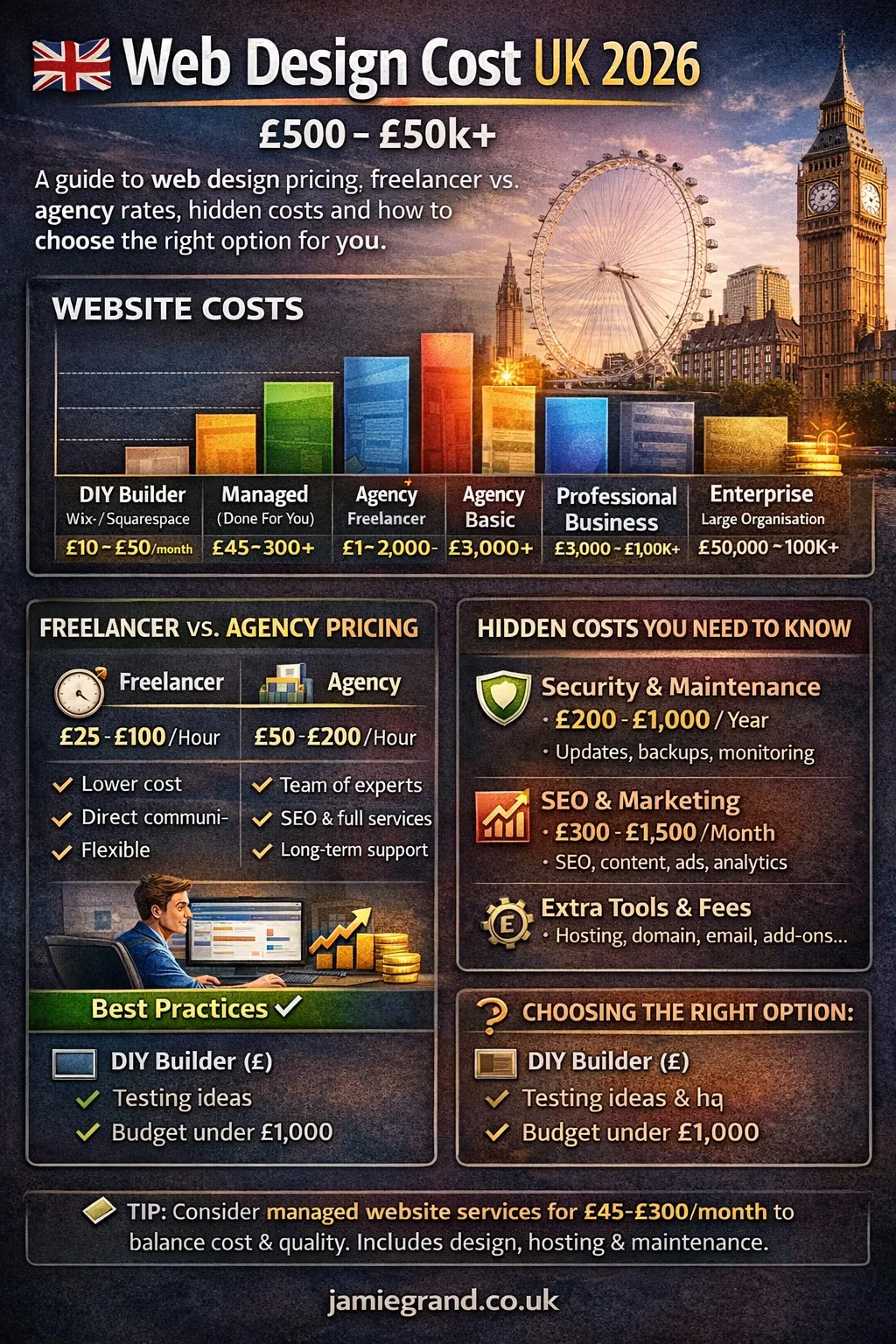
Let’s break down costs by what you’re actually building. The biggest price driver isn’t how many pages you have—it’s the complexity of what those pages need to do.
DIY Website Builders (£10-£50/month)
If you’re testing a business idea or need something simple, website builders like Wix, Squarespace, and GoDaddy offer the cheapest route.
// Platform Comparison 2026
| Platform | Monthly Cost | Best For | SEO Capability |
|---|---|---|---|
| Wix | £9-£27 | Beginners, portfolios | Limited |
| Squarespace | £12-£35 | Creatives, small shops | Moderate |
| GoDaddy | £8-£15 | Basic business sites | Limited |
| Shopify | £25-£259 | E-commerce focus | Good |
| WordPress.com | £4-£36 | Bloggers, content sites | Good |
What you get: Templates, drag-and-drop editing, basic hosting included.
What you don’t get: Custom functionality, full SEO control, unique design, ownership of your platform.
Real cost over 3 years: £360-£1,800 (plus your time learning the platform)
When DIY makes sense:
- You’re validating a business idea before investing
- Your website is purely informational with no lead generation goals
- You genuinely enjoy building things yourself
- Budget is genuinely constrained to under £1,000 total
// 💡 Budget tip
If budget is tight but you still want professional results, consider a managed website service (£0 upfront, £45/month) instead of DIY. You get professional design without the learning curve.
When DIY will cost you more:
- You need to rank on Google for competitive terms
- Your business relies on website leads or sales
- You need custom features (booking systems, portals, calculators)
- Your time is worth more than the money you’d save
Managed Website Services (£45-£300/month)
A growing alternative to both DIY builders and traditional agency builds: managed website services that combine professional design with an ongoing subscription model.
This approach—sometimes called “website-as-a-service”—eliminates the large upfront cost by spreading it across monthly payments, while including hosting, maintenance, and updates in one fee.
/* Traditional vs Managed Model */
| Feature | Traditional Model | Managed Website Service |
|---|---|---|
| Upfront cost | £1,500-£5,000+ | £0 |
| Monthly cost | £50-£200 (hosting + maintenance) | £45-£300 (all-inclusive) |
| Who updates content | You (or pay per change) | Provider handles it |
| Technical maintenance | Your responsibility | Included |
| SEO foundation | Often extra | Usually included |
// Service Tiers
Zero Websites — £45/month For tradespeople and local service businesses who need a professional online presence without the tech headaches. Includes custom design, hosting, SSL, security, and concierge-style content updates. You text a change request; it gets done.
Managed Growth — £300/month For businesses ready to grow traffic, not just maintain a site. Includes everything above plus monthly SEO content, Google Business management, and competitor monitoring. Ideal when you want your website actively working to bring in new customers.
When managed services make sense:
- You want professional quality without £2,000+ upfront
- Ongoing costs are easier to budget than lump sums
- You’d rather text someone than learn WordPress
- Your cash flow is healthy but capital is tight
- You value your time over DIY savings
When traditional makes more sense:
- You want full control and ownership from day one
- Your business model requires heavily custom functionality
- You have in-house technical capability
- You prefer one-time costs over subscriptions
Basic Brochure Websites (£500-£3,000)
A “brochure” website is what most small businesses actually need: a professional online presence with pages for home, about, services, and contact.
What’s included at this price point:
- 5-10 page website
- Mobile-responsive design
- Contact form
- Basic on-page SEO setup
- SSL certificate
- Content management system (usually WordPress)
What’s not included:
- Copywriting (you provide the text)
- Professional photography
- E-commerce functionality
- Custom integrations
- Ongoing maintenance
Realistic pricing by provider:
| Provider Type | 5-Page Site | 10-Page Site |
|---|---|---|
| Offshore freelancer | £300-£800 | £600-£1,200 |
| UK junior freelancer | £500-£1,200 | £1,000-£2,000 |
| UK experienced freelancer | £1,200-£2,500 | £2,000-£3,500 |
| Small UK agency | £2,500-£4,000 | £3,500-£5,500 |
Red flags at the budget end:
- No discovery call to understand your business
- Using extremely outdated platforms
- No mobile responsiveness guarantee
- Unclear ownership terms
Professional Business Websites (£3,000-£10,000)
This is where most serious UK businesses land. At this price point, you’re paying for strategy, not just execution.
What £5,000-£8,000 typically buys:
- Strategic planning and competitor analysis
- Custom design (not templates)
- Professional UX consideration
- Comprehensive SEO foundation
- Integration with business tools (CRM, email marketing)
- Training on managing the site
- Post-launch support period
What separates this from cheaper options:
- A designer asks why before designing
- Pages are built around conversion goals, not just information
- Site architecture considers Google rankings
- Performance optimisation is standard
- You get a genuine business asset, not just an online brochure
Custom/Bespoke Websites (£10,000-£50,000)
Bespoke websites are built from scratch to solve specific business problems. At this level, you’re not buying a website—you’re commissioning a custom software solution. See examples of bespoke projects →
What justifies this price:
- Customer portals or login areas
- Complex booking/scheduling systems
- Integration with multiple third-party services
- Custom calculators or configurators
- Multi-language functionality
- Unique interactive features
Example projects at this tier:
- Property portal with search and filtering: £15,000-£25,000
- Multi-location business with booking: £12,000-£20,000
- Membership site with gated content: £10,000-£18,000
- Custom product configurator: £15,000-£35,000
E-commerce Websites (£2,000-£30,000+)
Selling online adds significant complexity. Your website becomes a 24/7 sales machine that must handle payments, inventory, shipping, and customer data securely.
// E-commerce Pricing Breakdown
| Complexity Level | Products | Features | Cost Range |
|---|---|---|---|
| Basic | 1-50 | Simple checkout, PayPal/Stripe | £2,000-£5,000 |
| Standard | 50-500 | Filtering, variants, abandoned cart | £5,000-£12,000 |
| Advanced | 500+ | Custom pricing, integrations, B2B | £12,000-£30,000 |
| Enterprise | 1,000+ | Multi-warehouse, ERP integration | £30,000-£100,000+ |
Platform costs (additional to design):
- WooCommerce: £0 base + hosting (£150-£500/year)
- Shopify: £25-£259/month + transaction fees
- BigCommerce: £22-£240/month
- Magento: £0 base but £500-£2,000/month hosting
Ongoing Costs: The Full Picture
Your website isn’t a one-time purchase. Budget for these annual costs. For the maintenance line specifically, our UK maintenance cost guide verified every published plan price in July 2026 — and if you’d rather cap the whole line at one number, our managed maintenance plan is £45/month all-in.
Web Hosting (£100-£600/year)
// Hosting Cost Comparison
| Hosting Type | Annual Cost | Suitable For |
|---|---|---|
| Shared | £50-£150 | Very small sites, low traffic |
| VPS | £150-£400 | Business sites, moderate traffic |
| Managed WordPress | £200-£500 | WordPress sites wanting hands-off management |
| Dedicated/Cloud | £500-£3,000+ | High-traffic, e-commerce, enterprise |
What affects hosting cost:
- Traffic volume
- Storage requirements
- Security needs
- Speed requirements
- Support level
Domain Name (£10-£50/year)
- .co.uk: £8-£15/year
- .com: £10-£20/year
- Premium domains: £50-£1,000+/year
SSL Certificate (£0-£200/year)
- Basic SSL (Let’s Encrypt): Free (often included with hosting)
- Extended Validation SSL: £50-£200/year
Maintenance & Updates (£200-£2,000/year)
// Maintenance Plans
| Service Level | Monthly Cost | Annual Cost |
|---|---|---|
| Basic (security updates only) | £20-£50 | £240-£600 |
| Standard (updates + monthly backup check) | £50-£100 | £600-£1,200 |
| Comprehensive (updates, content changes, monitoring) | £100-£200 | £1,200-£2,400 |
| Premium (priority support, regular reviews) | £200-£500 | £2,400-£6,000 |
What maintenance includes:
- CMS and plugin updates
- Security monitoring
- Regular backups
- Performance monitoring
- Minor content changes
- Technical support
// 💡 Simplify ongoing costs
Managed website services bundle hosting, SSL, security, and maintenance into one monthly fee (from £45/month). For businesses who’d rather not manage separate vendors, this can simplify budgeting and eliminate surprise costs.
Content Updates
If you can’t update content yourself:
- Ad-hoc changes: £30-£75/hour
- Monthly content retainer: £100-£400/month
And the ones most guides skip. These catch businesses off guard after launch.
Professional Email (£40-£150/user/year)
your@company.co.uk requires:
- Google Workspace: £50-£150/user/year
- Microsoft 365: £45-£175/user/year
- Budget options: £20-£40/user/year
Security Costs
- Web Application Firewall: £10-£30/month
- Malware scanning: £5-£20/month
- Security monitoring: £20-£100/month
Cost of NOT investing: A hacked website can cost £5,000-£50,000+ in recovery, lost business, and reputation damage. According to the UK Government Cyber Security Skills Report, 50% of UK businesses experienced a cyber attack in 2024.
SEO & Marketing
A website without traffic is like a shop in the desert.
| Service | Monthly Cost |
|---|---|
| Basic SEO maintenance | £200-£500 |
| Active SEO campaign | £500-£2,000 |
| Content marketing | £300-£1,500 |
| PPC management | £300-£1,000 + ad spend |
// 💡 Bundled option
Managed Growth plans (£300/month) include 2x SEO articles monthly, Google Business management, and competitor monitoring—often cheaper than hiring these services separately.
Analytics & Tools
- Google Analytics 4: Free
- Heatmaps (Hotjar/Microsoft Clarity): £0-£100/month
- SEO tools (Ahrefs, SEMrush): £80-£400/month
- Form/CRM integration: £0-£100/month
Legal & Compliance
- Cookie consent solution: £0-£40/month
- Accessibility audit: £300-£2,000 (one-off)
- Privacy policy/terms: £100-£500 (one-off, or use templates)
If You’re in East London or Essex
The prices above are national. What changes locally is not usually the rate, it’s what you need: a trade business covering Walthamstow, Chingford or Woodford needs to be found in local search and to answer the phone, while an online shop shipping nationwide has different problems.
I build and run sites for businesses across East London and Essex from Highams Park. One developer, custom-coded, no agency overhead. Fully managed from £45/month on a twelve-month minimum, or a one-off build quoted on what it needs.
Cost by Provider: Freelancer vs Agency
The same project can cost £1,000 or £15,000 depending on who builds it. Broadly, you are paying for overhead and for how many people touch the work.
| Provider | Typical rate | Basic site | Professional site | What you get |
|---|---|---|---|---|
| Freelancer | £25-£100/hour (£200-£800/day) | £500-£3,000 | £2,500-£5,000 | Direct contact with the person building it, lower overhead, single point of failure |
| Small agency (2-10) | £400-£1,200/day | £3,000-£8,000 | £6,000-£15,000 | Combined design, dev and SEO skills; cover if someone is away |
| Large agency (10+) | £800-£1,500+/day | £10,000-£20,000 | £15,000-£40,000 | Project managers, formal discovery, documentation, long-term support |
Specialists in a niche charge £100-£150/hour. E-commerce runs higher everywhere: £8,000-£25,000 at a small agency, £30,000-£100,000+ at a large one.
// Same Project, Different Providers
A 10-page business website with a contact form, basic SEO and mobile responsiveness:
| Provider | Estimated Cost | Timeline | Support |
|---|---|---|---|
| Offshore freelancer | £800-£1,500 | 2-4 weeks | Limited |
| UK freelancer | £2,000-£4,000 | 3-6 weeks | Variable |
| Small UK agency | £4,000-£8,000 | 4-8 weeks | Defined |
| Large UK agency | £12,000-£20,000 | 8-12 weeks | Comprehensive |
Factors That Affect Price
Beyond website type and provider, these factors swing prices significantly.
Design Complexity
Template-based: Using pre-designed themes with customisation: reduces cost 30-50%
Custom design: Original layouts, graphics, animations: standard pricing
Premium design: Award-worthy aesthetics, micro-interactions, unique experiences: +50-100%
Functionality Requirements
Each addition increases cost:
- Contact forms: £0-£200 (often included)
- Blog/news section: £200-£500
- Booking/scheduling: £500-£2,000
- Customer accounts: £1,000-£3,000
- Payment processing: £500-£2,000
- Search functionality: £300-£1,500
- Multi-language: £1,000-£5,000+
- Third-party integrations: £500-£3,000 each
Content Creation
Most quotes assume you provide content. If you need it created:
| Service | Cost |
|---|---|
| Basic copywriting | £150-£300/page |
| SEO copywriting | £250-£500/page |
| Professional photography | £300-£800/day |
| Stock photos | £10-£50/image (or £15-£30/month subscription) |
| Video production | £500-£5,000+ |
Timeline
Rush jobs cost more:
- Standard timeline: base price
- 50% faster: +25-50% cost
- “We need it next week”: +50-100% cost (or declined)
Geographic Location
UK regional variation:
- London: +20-40% vs. national average
- Southeast: +10-20%
- Midlands, North, Wales, Scotland: standard pricing
- Remote-first agencies: often competitive regardless of location
ROI Analysis: Is Expensive Worth It?
Let’s look at real numbers to see when paying more makes sense.
Scenario A: £1,500 Website
Investment:
- Build: £1,500
- Annual hosting/maintenance: £300
- 3-year total: £2,400
Result:
- Basic online presence
- Limited Google visibility
- Generates 0-5 leads/month
- Conversion rate: 1-2%
3-year lead value: ~£5,400-£10,800
Scenario B: £6,000 Website + £500/year SEO
Investment:
- Build: £6,000
- Annual hosting/maintenance: £600
- Annual SEO: £500
- 3-year total: £9,300
Result:
- Professional, strategic site
- Ranking for target keywords
- Generates 15-30 leads/month
- Conversion rate: 3-5%
3-year lead value: ~£32,400-£108,000
The Reality
A £6,000 website that generates 20 qualified leads/month is infinitely better value than a £1,500 website that generates 2. The ROI calculation isn’t about what you spend—it’s about what you get back.
Questions to ask:
- How much is a new customer worth to your business?
- How many customers would pay for the website investment?
- What’s the cost of NOT having an effective website?
For most B2B services where customer lifetime value exceeds £2,000, a professional website pays for itself within months.
How to Choose the Right Option
Choose DIY Website Builder If:
- Total budget under £500
- You’re testing a business concept
- The website is informational only (no lead generation goals)
- You enjoy learning new software
- SEO rankings don’t matter for your business model
Choose a Managed Website Service If:
- You want professional design without £2,000+ upfront
- Monthly payments work better than lump sums for your cash flow
- You’d rather focus on your trade than learn web software
- You want hosting, SSL, updates, and maintenance handled for you
- You’re a tradesperson, local service business, or SME
- You value “text me and it’s done” over DIY control
Best fit: Zero Websites (£45/month) for straightforward presence, or Managed Growth (£300/month) if you want ongoing SEO content and traffic building.
Choose a Freelancer If:
- Budget is £1,000-£4,000
- Project is straightforward (brochure site, simple blog)
- You can manage the project yourself
- You have time to find a reliable individual
- You have clear requirements already
Choose a Small Agency If:
- Budget is £3,000-£15,000
- You need strategy guidance, not just execution
- SEO and lead generation are important
- You want a long-term relationship
- Project involves multiple disciplines (design, development, content)
Choose a Large Agency If:
- Budget exceeds £15,000
- You need enterprise-grade security and compliance
- Multiple stakeholders require formal process
- Complex integrations are needed
- Brand reputation is critical
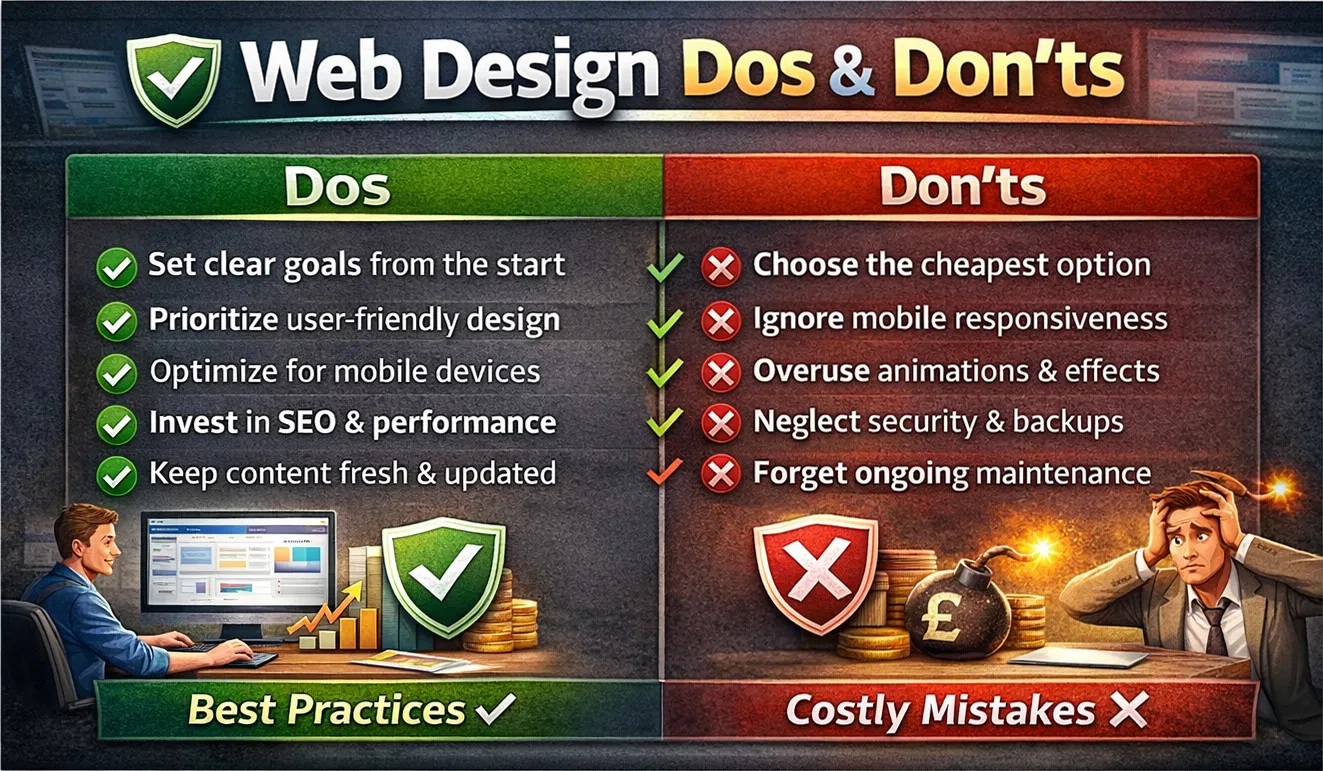
Red Flags to Avoid
Run away if:
- No contract or unclear terms
- Won’t show portfolio of similar work
- Quotes without asking about your business goals
- Promises “page 1 of Google” guaranteed
- Unusually low price with no explanation
- No clear process or timeline
- Wants 100% payment upfront
Frequently Asked Questions
How much do web designers charge per hour in the UK?
Freelance rates commonly run £25-£100 an hour, with agencies higher. Hourly pricing suits small fixes; for a whole site, a fixed quote protects you from the meter.
What does a five-page website cost?
Page count is a weak guide to price. Five simple pages from a freelancer might be £500-£3,000; five pages with a booking system, a customer area or a shop can cost several times that. What the pages do sets the price.
Why is web design so expensive?
Most of the cost is time, not software: working out what the site must achieve, writing and structuring it, building it to load fast and be found, then testing it. Budget options save that time by handing you a template and leaving the rest to you.
What should a small business budget in 2026?
For a straightforward professional presence, plan for either £45-£300 a month managed, or roughly £1,500-£5,000 up front plus £200-£2,000 a year to keep it running.
Is a website builder good enough?
Sometimes. If your site is a digital business card and you enjoy the tinkering, a builder is fine. If it has to bring in work, be found for competitive searches, or do anything custom, you will outgrow it.
How much does website maintenance cost?
£200-£2,000 a year as a standalone cost, or included in a managed service. See the maintenance cost guide for the breakdown.
Conclusion
Web design costs in the UK range from free DIY options to six-figure enterprise projects. For most UK small businesses, the sweet spot is £3,000-£8,000 for a professional website that actually generates leads and grows with your business.
The key insight: don’t just compare prices—compare what you get for your money. A £1,500 website that generates no leads is infinitely more expensive than a £6,000 website that brings in £50,000 of new business annually.
Your next steps:
- Define what your website needs to do (not just how it should look)
- Calculate what a new customer is worth to your business
- Set a realistic budget based on expected ROI
- Get 3 quotes from appropriate providers (compare like with like)
- Ask to see relevant portfolio examples and client references
/* Ready to get started? */
Zero Websites — £0 upfront, £45/month Professional managed sites for tradespeople and local businesses. No tech skills needed. Just text me when you need changes.
Managed Growth — £0 upfront, £300/month Everything in Zero Websites plus monthly SEO content, Google Business management, and competitor intel. For businesses ready to grow traffic.
Bespoke Solutions — Hourly or fixed quote Custom builds and one-off fixes on WordPress, Shopify, React, or Laravel. From 1-hour bug fixes to complex integrations.
Not sure which fits? Explore all web development options →
References
-
UK Government. Cyber Security Skills in the UK Labour Market 2024. Report on cyber security incidents and business preparedness. Available at: https://www.gov.uk/government/publications/cyber-security-skills-in-the-uk-labour-market-2024/cyber-security-skills-in-the-uk-labour-market-2024
-
OECD. Digital Economy Outlook 2024 (Volume 2). Analysis of digital business trends and investment patterns. Available at: https://www.oecd.org/en/publications/oecd-digital-economy-outlook-2024-volume-2_3adf705b-en.html
-
UK Government. Artificial Intelligence Sector Study 2024. Department for Science, Innovation and Technology report on digital services growth. Available at: https://www.gov.uk/government/publications/artificial-intelligence-sector-study-2024/artificial-intelligence-sector-study-2024
-
UK Government. UK Business Activity, Size and Location 2024. Statistics on UK business demographics. Available at: https://www.gov.uk/government/statistics/uk-business-activity-size-and-location-2024